Promoting healthier habits in college students through a nostalgic and playful accountability partner for intrinsic motivation.
PROJECT DETAILS
TYPE
Designathon
TIMELINE
Nov 2023
TEAM
4 Designers
DISCIPLINE
Product Strategy
UX/UI Design
Visual Design
PROJECT SUMMARY
DoorDash’s mission is to revolutionize food delivery by providing a convenient and health-conscious experience for all users, especially college students. However, college students still struggle to eat healthily due to limited options, busy schedules, and tight budgets.
Our mission was to design an experience to encourage college students to be more conscious of their health. We introduced Dash, the DoorDash Dog that acts as an accountability partner to motivate users to eat healthier.
CONTEXT
Access to meals has never been easier thanks to food delivery services.
It provides a convenient solution to those who don’t have the time, energy, or ability to get/make meals themselves… AKA most college students.
THE PROBLEM
Students typically order unhealthy on delivery apps, negatively impacting their health.
Preliminary research on the current landscape of food delivery apps reveals how despite being a convenient resource, it often ends up being damaging to students and their health.
75%
of students order food online at least once a week.
– JOURNAL OF LIFESTYLE MEDICINE
2 in 3
students believe that food delivery apps negatively impact their heatlth.
– JOURNAL OF NUTRITIONAL SCIENCES
61%
of online orders were found to be unhealthy.
– UNIVERSITY OF SOUTH FLORIDA
How might we encourage college students to be more conscious of their health and diet?
Understanding why and in what situations students use DoorDash.
Laziness
Many students are too exhausted from their responsibilities to cook.
Late at night
Limited late-night dining options and safety concerns make delivery a preferred choice, though options tend to be unhealthy.
No car
Students without a car have fewer food options, making delivery a more accessible solution.
Understanding what influences students' DoorDash orders.
Cravings
Students order based on specific food cravings, often leading to unhealthy choices.
Affordability
High delivery and service fees make cost a key consideration, with healthier options generally being more expensive.
Friends suggestions
Peer recommendations shape eating habits, reinforcing shared preferences for healthy or unhealthy foods.
KEY INSIGHTS
DoorDash's use-case inherently entails unhealthy choices.
Many of the leading reasons college students use DoorDash and the main drivers of the choice of their orders point to unhealthy choices. Therefore, we were faced with the unique challenge of attempting to change the main use-case of DoorDash.
IDEATION
Structured ideation for impactful solutions.
Keeping all of the above in mind, we decided to use the diverge-converge brainstorming method because it would generate the most amount of ideas in a short period which was necessary given the limited time we had.
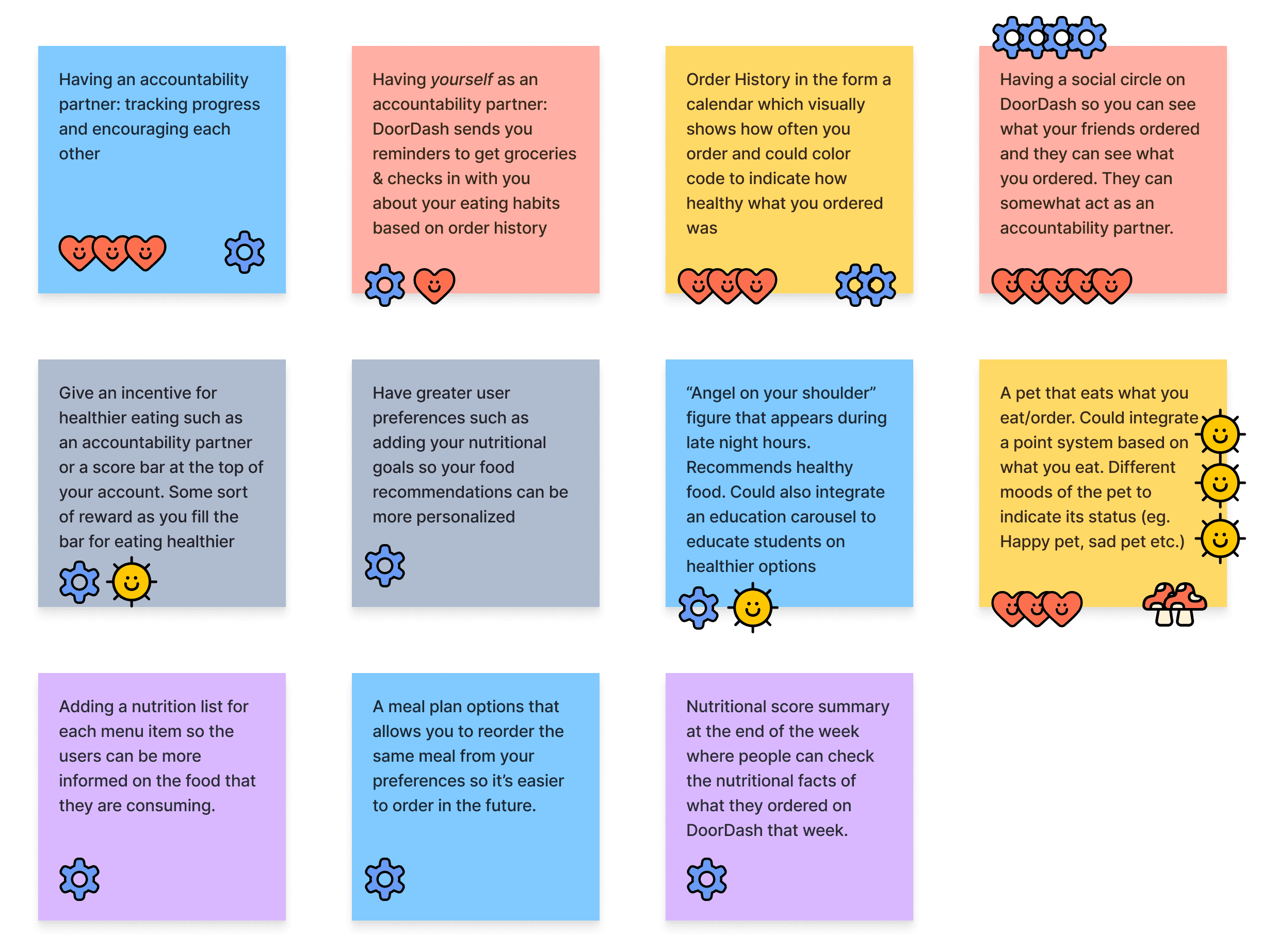
After we individually brainstormed solutions, we placed the following markers on the ideas we came up with to help us categorize and organize our thoughts.

TANGIBLE
Practical and likely to be implemented

DELIGHTFUL
Most likely to delight

LIKE
Any idea we personally liked

BLACK HORSE
Most out of the box idea we like
CONSTRAINTS AND GOALS
DoorDash is not a health app, and thus our solution should not present itself as such.
While this would pose many restrictions as the use case of DoorDash often entails unhealthy food, it was crucial that we did not deviate from their brand identity.
DoorDash is not a health app, and therefore our solution should not present it as so. Instead, it should be subtle such that it seamlessly fits into their brand.
FINAL SOLUTION
Gamifying healthy habits for intrinsic motivation through an accountability partner.
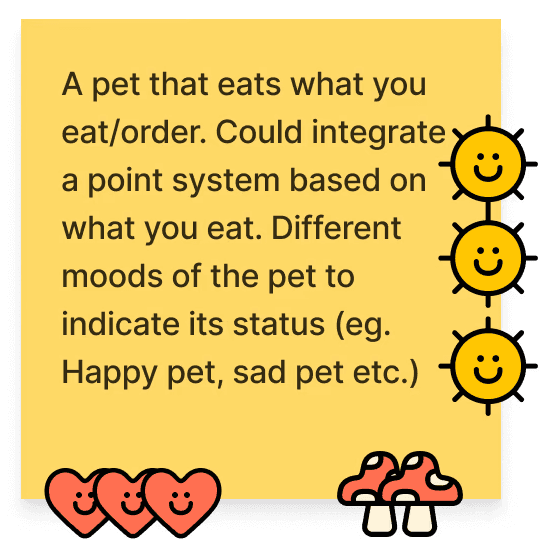
As a team, we converged on the idea of the pet that "eats" what you eat to act as an accountability partner. It aligns with DoorDash's brand identity, appeals to the target user of college students, and integrates many of the common themes from our ideation. This solution would hold users accountable (but not too accountable) to encourage healthy habits.
CONSIDERATIONS
A closer look at the details and considerations for a seamless brand fit.
What should the pet be?
Because we didn't want to make this virtual pet a dominant feature in DoorDash, it was important that this feature felt seamless and natural. Thus, we ultimately decided on the most "pet" pet of them all – a dog.
What should it look like?
To match the design of the pet to DoorDash's brand as much as possible, I referenced DoorDash's existing illustrative style.

Using Procreate, I drew the dog to replicate this style.


Where should it be?
We struggled to find the right balance between the visibility and subtlety of the virtual pet. We wanted it to be noticeable enough to reinforce accountability without dominating the interface or disrupting the user experience. Additionally, we placed the virtual pet in a ‘room’ to strengthen the sense of ownership and connection, reinforcing the idea that it is truly the user’s pet.
FINAL SOLUTION
Meet Dash, the DoorDash Dog – Your companion to eating healthy.
Dash is an accountability partner to encourage college students to eat healthier. Dash's health and mood will be based on the user's recent orders.
Healthy orders = Happy Dash, Unhealthy orders = Sad Dash
WHY IT WORKS
Dash promotes healthier eating through active feedback, helping users make informed and mindful choices.
According to Pearson’s Law, performance improves when measured and improves exponentially when both measured and reported. Publicly committing to goals increases the likelihood of completion to 65%, while having an accountability partner raises the success rate to 95% (Source: The Medium).
Here are some other reasons why Dash would be an effective companion:
Mindful eating habits
Using the visual indicator of Dash's health, users will be more mindful of their orders.
Informed food choices
The nutritional tracking system allows users to stay informed of their intake and keep track of their orders.
Reward system
Peer recommendations shape eating habits, reinforcing shared preferences for healthy or unhealthy foods.
REFLECTION
This project remains one of my favorite to this day. Share your fun, out-of-the box ideas.
I loved working on this project and I am so proud of my team and I for what we accomplished in 5 hours.
Overall, I believe we were able to analyze the problem and break it down into its most essential components well. We came up with a unique solution that stays true to DoorDash’s brand and would tangibly encourage college students to eat healthier. For future considerations, we could potentially introduce a social feature so users can share their customized pet and their wellbeing with others, as well as rethink the placement of Dash.